Showing posts with label conference. Show all posts

April 11, 2011

ATA plans its 52nd annual conference

The American Translators Association (ATA) will host its 52nd Annual Conference in Boston, Massachusetts (October 26-29). This conference showcases diverse panel discussions, expert presentations, training workshops, and scholarly papers. Both general and language-specific sessions will be offered. The conference also offers language professionals one of the best opportunities to network with colleagues. Additional conference activities include a Job Marketplace, a vendor exhibit hall, and ATA certification testing. For conference information see http://www.atanet.org/conf/2011/

For questions, contact Maggie Rowe, Membership Services Manager.
Phone: +1-703- 683-6100, extension 3001
Email: Maggie@atanet.org

March 4, 2010

ATA 51st Annual Conference Presentation Proposals Due March 8

The American Translators Association is now accepting presentation proposals for ATA's 51st Annual Conference in Denver, Colorado (October 27-30, 2010).

Submissions are invited from all areas of translation and interpreting, including financial, legal, medical, literary, media, science and technology, terminology, training and pedagogy, independent contracting,and language services providers. Sessions may be language-specific or general.

All proposals are selected through a competitive peer-review process.

As the current Administrator of the French Language Division I would like to encourage the "experts" among you to make a presentation at the ATA's Annual Conference this Fall in Denver, Colorado. This will offer you a unique opportunity to enhance your professional standing. ATA also offers speakers discounted conference registration fees.

If you do decide to present a paper, please make sure that you select "French" as the "Topic of presentation" if it is related to the French Language of course! This is a separate selection from the "presenting language" where you can select either French or English depending on the language you are most comfortable in for your presentation.

Visit http://www.atanet.org/conferencesandseminars/proposal.php to learn more about the proposal process and to access the proposal form.

The deadline for submitting a presentation proposal is March 8, 2010.

Thank you very much for your willingness to share your precious knowledge with your peers!
__________________________________________________

FOR QUESTIONS RELATED TO THE FRENCH LANGUAGE DIVISION PRESENTATIONS:
Contact: Virginia Fox, FLD Administrator

FOR ADMINISTRATIVE QUESTIONS?  NEED INFO?
Contact Maggie Rowe, Membership Services Manager
Phone: (703) 683-6100
Email: Maggie@atanet.org
__________________________________________________

MAKE PLANS NOW TO ATTEND!!

ATA 51st Annual Conference
Hyatt Regency Denver
Denver, Colorado
October 27-30, 2010

December 31, 2009

Conference session review: “Research Techniques for French to English Legal Translation” (session LAW-2) by Cynthia L. Hazelton, JD, Hazelton Translations

Review by Eugenia Tumanova, Quality Manager, Legal & Intellectual Properties, TransPerfect Translations. Contact: eugenia@tumanova.org. Session description here.

Most translators, including those who do not seek it out, are eventually asked to translate a legal document. Occasional and seasoned legal translators alike seek reliable dictionaries, glossaries, and well-organized reference documents and websites to help them achieve utmost accuracy and clarity in their translations. Therefore, it should come as no surprise that this presentation was eagerly awaited at the annual conference, as was evident from the number of people in attendance.

An affable and clear communicator, Cynthia L. Hazelton, JD, drew on her teaching experience and a background in law to guide us through the basic issues in legal translation, give us an overview of the types of resources used to research legal terminology, and illustrate the main points of the presentation through examples.

A legal translator has to ask some of the same questions as a translator in any other field: What is the purpose of the text? Who is its intended audience? What register should be used? However, the legal translator is further challenged by the convoluted style of legal writing, the use of common words having entirely different meanings in legal contexts, and a vocabulary otherwise absent from regular discourse. As if that were not enough, the legal translator must probe further to identify the legal system that serves as the framework of the document and recognize any additional differences in legal concepts and terminology that might exist between the country in which the document originated and the country where the translation will be used.

After a discussion of the broad differences between civil law, common law, combined civil and common law, and the various religious law systems that exist, Hazelton showed a map that illustrated that it is crucial for a French-English translator to be knowledgeable about the different systems of law: all four systems exist in the French-speaking world.

Hazelton identified three categories of resources available to the legal translator. Primary resources are the original legislative codes, laws, treaties, court decision, and trial transcripts. Secondary sources interpret, evaluate, and comment on the primary documents and can take the form of articles in scholarly journals, criticism or commentary, magazine or newspaper articles. Many international organizations, such as the United Nations, the North Atlantic Treaty Organization, the World Trade Organization, and the World Health Organization, to name a few, publish works that fall in this category, and frequently these publications are in English and French. Finally, tertiary sources, which include encyclopedias, dictionaries, glossaries, and textbooks, distill information from primary and secondary sources. While these are undeniably useful resources, translators must not become “stuck” working solely with tertiary resources, and should be prepared to dig through secondary and primary resources when searching for the right term.

Finally, Hazelton reminded us to never underestimate the value of an expert’s opinion. As we build our own lists of favorite resources, develop our personal glossaries, and nurture our professional networks, it would behoove every dedicated legal translator to build contacts with experts in the fields of legal translation and law, colleagues that could be called on in a pinch to demystify a tortuous sentence or resolve a terminology conundrum.


Resources

Suggested Reading on Common and Civil Law
Cairns, W. 1995. Introduction to French Law. Routledge Cavendish.†
Canadian Bar AssociationOntario, et. al. 1994. The New Civil Code: A Practical Guide to What Every Ontario Lawyer Needs to Know about Québec Law. Ottawa: CBAO.
David, R. and De Vries, H. 1958. The French Legal System: An Introduction to Civil Law Systems. Oceana Publications.†
Glendon, M., Carozza, P. and Picker, C. 2008. Comparative Legal Traditions in a Nutshell. West.
Kempin, F. 1990. Historical Introduction to Anglo-American Law in a Nutshell. West Group Publishing.
Merryman, J. and Perez-Perdomo, R. 2007. The Civil Law Tradition: An Introduction to the Legal Systems of Europe and Latin America. Stanford University Press.
Séroussi, R. 2003. Introduction aux droits anglais et américains. Dunod.†
Weston, M. 1991. An English Reader’s Guide to the French Legal System. Berg Publishers.

Monolingual Legal Resources (Print)
Garner, B. ed., Black’s Law Dictionary†† (English)
Boyé, E. 2001. L’anglais des contrats internationaux. Litec.†
Cohen, M. 2007. Legal Research in a Nutshell. Thomson West.
Corbière, F. 1993. Les mots-clés du droit. Breal.

Bilingual Legal Resources (Print)
Bridge, F. H.S. 1994. The Council of Europe French-English Legal Dictionary. Council of Europe.††
Dhuicq, B. and Frison, D. Lexique bilingue de l’anglais juridique. Pocket.†
Guillien, R. and Vincent, J. 2010. Lexique des termes juridiques. Dalloz-Sirey.
Kurgansky, A., et al. 1992. Dictionnaire économique et juridique. L.G.D.J.
Robert & Collins Super Senior French to English and English to French Dictionary. 2 Volumes. ††
de Saxcé, F. 2007. Dictionnaire comptable, fiscal et financier. French & European Publications.††

Monolingual Legal Resources (Online)
Avocat On-line *** (French)
BBP Avocats *** (French)
Droit Pratique *** (French)
French Ministry of Justice: Les Mots Clés de la Justice *** (French)
Harvard Law School: One-L Dictionary *** (English)
Harvard Law School: Canadian Legal Research Guide ** (English)
Tjaden, T. 2008. Doing Legal Research in Canada - Introduction: The Canadian Legal System http://www.llrx.com/features/ca_intro.htm ** (English)
United States Code * (English)

Bilingual or Multilingual Legal Resources (Online)
French Civil Code in French (PDF format) and in English here and here. *
Greffe du Tribunal de Commerce de Paris, French-English Dictionary for Use at the Greffe du Tribunal de Commerce de Paris (PDF format) ***
Québec Civil Code (in English and in French) *

General Online Resources ***
InterActive Terminology for Europe (IATE)


* Primary sources
** Secondary sources
*** Tertiary sources
† Out of print/limited availability, check your library and second hand stores
†† Indispensable, according to the presenter.

Disclaimer:
Hyperlinks to Amazon.com listings are provided for information only and is not an endorsement of this bookseller over any other.

December 17, 2009

Conference session review: “Anatomy of a Patent” (session LAW-8) by Dr. Bruce D. Popp

Review by Stephanie Strobel

Bruce D. Popp was awarded a Ph.D. in astronomy by Harvard University. A former telecom professional, he now translates technical subjects from French to English. He has near-term plans to sit for the US Patent and Trademark Office registration exam to become a Patent Agent.

Dr. Popp shared a slice of his intimate knowledge of US and European patents during his presentation “Anatomy of a Patent” at the 50th ATA Annual Conference held in New York City. At the start of the session Dr. Popp provided a list of resources (see the end of this article).

Prior to the dissection of the selected specimen, Dr. Popp shared some of the types of patents that exist: Utility, Design, and Plant. Among other things, we learned what can be patented: “any new and useful process, machine, manufacture, or composition of matter, or any new and useful improvement thereof,” and what cannot be patented: natural phenomena, mathematical algorithms and purely mental concepts.

The subject of the dissection was the patent for an item we could easily grasp: a humble pizza box with an improved closure, US Patent 5,702,054. Dr. Popp discussed the cover page of our specimen, pointing out what to expect and noting what was missing from this particular patent.

We got an up close and personal look at the form and content of the claims section. To be able to file a patent application, it must have at least one claim. Claims can be independent or dependent. An independent claim stands on its own and might describe a widget for example, while a dependent claim refers back to a previous claim and further restricts the subject of the claim, perhaps specifying that the widget is blue. Dr. Popp stated that the US Patent Office charges additional fees for patents with over three independent claims or more than 20 total claims.

Dr. Popp highlighted the differences, US vs. Europe, regarding “multiply dependent” claims. A multiply dependent claim is a dependent claim that refers back to more than one previous claim. European practice makes extensive use of multiply dependent claims, while US Patent Office rules limit the use of multiply dependent claims and charge additional fees when they are used. One interesting and possibly confusing feature of the US patent is that even though it has numerous headings, the most important section, the claims section, ironically has no heading at all.

Though the queries from attendees tempted him, Dr. Popp deftly avoided delving into the physiology of the patent and remained focused on its anatomy.

By the way, Dr. Popp’s personal favorite patent is US Patent 5,406,549 in the telecom sector.

Here are Dr. Popp’s recommendations for those interested in developing patent translation skills:

1. Find a patent in your target language, in a domain you are comfortable with, and become familiar with the format and terminology.

2. Press on. Patents repeat information three times. So if you don’t understand something, continue reading and it may be explained more clearly later in the document.

3. Your translation must be faithful to the original text. Don’t add anything. If you find an error (suppose the source says “up” when it should obviously say “down”), it is best to make a note of this on a separate sheet of translator’s notes. You may also make a note of any other problem. Making corrections is the patent practitioner’s job. The translator’s notes will make that job easier. Your client may of course have a different preference.

Resources

Print Resources

Carroll, Alison, ed. The Patent Translator’s Handbook. Alexandria, Virginia: American Translators Association, 2007. (http://atanet.org/publications/index.php).

Pressman, David. Patent it Yourself, 14th edition, Nolo Press.

Internet Resources

Copies of Patents
http://www.freepatentsonline.com/ US, EP, PCT, and Patent Abstracts of Japan (English interface)

http://ep.espacenet.com/ EP, US, many other countries (English/French/German interface)

http://www.wipo.int/pctdb/en/ PCT Applications (interfaces in various languages)


Sources for Legislation, Regulation and Treaties
http://www.uspto.gov/web/offices/pac/mpep/mpep.htm (Title 35 of U.S. Code and Title 37 of Code of Federal Regulation, also Manual of Patent Examination Procedure)

http://www.epo.org/patents/law/legal-texts/epc.html European Patent Convention (governs European Patent Office) published in three languages, presented in parallel

http://www.wipo.int/pct/en/ Patent Cooperation Treaty, available in various languages

http://www.legifrance.gouv.fr/initRechCodeArticle.do (on the pull-down, choose Code de la propriété intellectuelle)


December 10, 2009

Conference session review: “Organisations Internationales : Un Défi À Relever” (conference seminar F-4) by FLD distinguished speaker Dr. Maite Aragonés Lumeras


Review by Alan Dages (photo below)


Dr. Aragonés began her presentation by saying that international organizations (IOs) represent a considerable share of the translation market and thus provide a steady flow of work. However, since the 1970s, their translators have had to follow manuals with rigid guidelines that cannot always be applied to the wide range of texts to be translated. At the present time, text revision is subjective in that reviewers make changes based on habit, preference and ideology. Much remains to be done to harmonize the revision function so revisers understand that their role is to control quality and provide training and not to call the translator’s ability into question. Greater tolerance is needed.

The IOs entered a “golden age” of translation in the 1970s and 80s as their mission turned to promoting multilinguism and multiculturalism. Translation became mandatory to the extent it became a part of the IOs’ corporate image. Organizations recruited large numbers of translators and interpreters to handle a growing workload. The United Nations (UN) unveiled its Manuel à l’usage des traducteurs in 1988 intended to train in-house translators and better harmonize their translations since several individuals could be working on a single text. By the mid-1990s, translation budgets had grown to the point that IOs hired fewer translators in house to reduce costs. They also began making greater use of outside translators for short-term projects just as the advent of the personal computer permitted outsourcing work to freelance translators working at home.

With the new millennium, outsourced translations were being revised in house and quality control became a hot topic. A growing volume of material to be translated, together with budget cuts, caused IOs to turn to terminology solutions such as databases and translation memories.

As things stand now, both the UN and the World International Property Organization (WIPO) use a thoroughly linguistic approach to translation based on a prescriptive method based on specific examples. By way of illustration, Dr. Aragonés cited examples from manuals, glossaries and guidelines developed at the UN and WIPO, where she has been a translator and reviser working in Chinese, English, Spanish and French since 1998. The manuals take a restrictive, case-by-case approach to guide the translator, and le mot est maître.
The UN manual states, “Les stagiaires ont intérêt à lire très attentivement..." and “Il convient, comme dans le cas de tous les textes à portée normative, de suivre l’original dans toute la mesure possible. […] En particulier : ne pas faire deux phrases là où l'original n'en comporte qu'une ou vice versa."

Translators are admonished to keep to the source text in a literal way while at the same time expressing the equivalent meaning in the target language's style and quality. Proper grammar must be used. Simplicity, clarity and conciseness are key. These general prescriptions are meant to serve equally well for all subjects, be they general, legal, technical, budgetary, political, administrative, economic or financial without factoring in the concept of text genre.
Hence, the UN prescribes, “Dans ce genre de textes, on se gardera tout autant d'interpréter l'original ou d'ajouter des mots qui n'y figurent pas.  Par exemple, une phrase telle que “Agrees in principle to the need of an expert group to assist the Committee...” est à traduire par “Reconnaît en principe qu'il est nécessaire qu'un groupe d'experts aide le Comité...” et non par "Reconnaît en principe la nécessité de créer un groupe d'experts pour assister le Comité”. Dr. Aragonés mentioned that it would, however, be possible to write “reconnaît en principe la nécessité de se référer/de s’en remettre à un groupe d’experts …” Even though a word has been added, the meaning has not changed.

Yet this prescriptive method inevitably results in apparent contradictions as in this quote from the UN manual under the heading, Qualité: “Le bon traducteur ne traduit pas mot à mot ni même phrase par phrase; d’instinct comme de raison, il se réfère à chaque instant au contexte.” This would appear to go against the previous advice to adhere to the source text while maintaining its sentence structure at all times.

IO guidelines contain a wealth of equivalencies, i.e. recommended translations from English to French of examples that may bear little resemblance to normal patent usage. These address such minutia as specific word choices as shown below:

  • Need : besoin, nécessité OMPI 08; exigence, impératif; s’impose ONU 88
  • compelling need à Il est absolument nécessaire
  • In need of à ayant besoin de, nécessitant (see “patient”)
  • patient/subject in need thereof à patient/sujet ayant besoin (d’un tel traitement), patient dont l’état nécessite (un tel traitement).
This proposal is in fact a translation that does not respect the conventions of patents written in French where the preferred use is “patients” or “malades” alone. Indeed, little is left to chance using this approach, but does it yield better translations?

IO manuals also contain examples of different types of texts that could be improved, which are offered only to illustrate the range of possible subjects the translator might encounter. Other guidelines include advice on abbreviations, capitalization, spelling and the use of gerunds.

Dr. Aragonés held out text genre as the guiding principle for a linguist working at the UN or WIPO, calling it the translator’s “GPS”. Aristotle was the first to study and write about text genre, but the notion took hold in literature and, much later, in cinematography. During the 1980s it turned up in sociolinguistics and rhetorics, particularly for teaching foreign languages to experts (Language for Specific Purposes, or LSP). Text genre originates from recurring situations and can be identified by the members of discursive communities who use it as a communications platform. The translator, as an outsider, can use text genre to glean missing contextual information, given she knows neither the issues and conventions nor even the intentions and objectives of the authors and readers. Far from being just a formal prototype, text genre socializes the members of a community, serving as a constantly changing model for negotiation among parties. Hence, it also socializes translators through the use of a corpus of texts, which becomes their documentation tools. This familiarizes them with IO conventions, thereby making it easier to produce a readable translation that meets the user’s expectations while keeping faithful to the author’s intentions.

Dr. Aragonés is currently training two fellows at WIPO’s PCT Translation Department based on text genre, which is the core of her teaching method known as “contextualization”. She uses this method to teach trainees how to translate from Chinese into French. The results are convincing, and the translation quality after two months’ training is excellent. The trainees now respect the formal patent conventions without betraying the intentions of the patent engineers and inventors.

A discussion ensued following the presentation in which a translator said the UN will train and restrict you at first, but if you are really competent, you will be given greater latitude. Another UN translator pointed out that manuals ensure adherence to conventions and harmonization.  Dr. Aragonés responded that there is still a great deal of disagreement between translators and revisers and among revisers themselves at international organizations. The subjectivity of language often results in drawn-out, fruitless and polemical debates if objective criteria are not defined. Translators and revisers must not impose their subjective choices; rather they should adhere to the text genre and formal conventions already chosen and negotiated between authors and their readers, who together form an integral part of a discursive expert community with clear objectives.
0

November 28, 2009

Mémoires de ma première conférence annuelle de l’ATA

de Manon King

Je redoutais un peu la conférence annuelle de l’ATA vantée depuis plusieurs mois dans la revue de l’association, The ATA Chronicle, qui promettait une participation de plus de 2 000 personnes, une perspective un peu intimidante pour une néophyte. Mais mon inquiétude a vite fondu au soleil de l’ATA !  L’arrivée au Marriott Marquis, l’hôtel de la conférence, après avoir fendu les flots humains sur Time Square m’a donné l’impression d’être en partance, avec toute une cohorte de touristes internationaux enthousiastes, pour une croisière en paquebot de luxe. Puis l’assistance souriante d’une volontaire à l’enregistrement, le programme bariolé des festivités, l’activité bourdonnante des anciens se retrouvant avec joie, les échanges spontanés avec d’autres conférenciers dans les ascenseurs futuristes, et la réception de bienvenue pleine à craquer m’ont rassurée : cette aventure allait être bien intéressante. Et comble de chance, ma chambre au 29ième étage avait une vue directe sur Times Square et ses panneaux publicitaires que j’ai bien entendu immédiatement (et sans grand succès à vrai dire) pris en photo avec mon portable pour impressionner mes enfants.


Le lendemain matin, je me suis rendue compte que la conférence de l’ATA a également des objectifs sérieux de rencontres et approfondissement pour linguistes professionnels de toute mouture. La journée a commencé avec un petit déjeuner fort apprécié et une réunion plénière bondée. Puis les participants se sont éparpillés parmi des dizaines de présentations spécialisées réparties dans un labyrinthe à multiple étages, soit pour tester le QI des conférenciers, soit pour nous faire faire un peu de sport d’autorité puisqu’il était évident que personne n’aurait le temps d’utiliser la salle de gym !

Sur les conseils d’Anne Vincent, j’ai assisté au séminaire destiné aux nouveaux conférenciers, bien utile pour comprendre les diverses pastilles de couleur, codes de présentation et autres subtilités si évidentes pour les anciens. La salle était pleine à craquer, de multiples questions ont fusé, les animatrices de la présentation ont gentiment calmé nos nerfs et surtout, j’ai compris qu’il fallait religieusement remplir la fiche rose de commentaires après chaque présentation pour peut-être gagner un prix ! En tant que novice de l’ATA, je me suis rendue ensuite à la séance sur la préparation de la fameuse certification ATA qui s’est avérée plus tendue que la première car 160 candidats s’apprêtaient à passer l’examen à la fin de la conférence et étaient visiblement nerveux. Les animateurs ont offerts des conseils précis, pratiques et utiles qui n’ont peut-être pas calmés les esprits fébriles mais ont clairement expliqué à quoi les candidats pouvaient s’attendre. La rigueur du processus de certification m’a impressionnée et encouragée à tenter l’examen, bien que le taux de réussite de 20 % soit un peu décourageant !

J’ai eu un peu de mal à choisir à quels autres séminaires assister, il y en a tellement, mais j’ai fini par opter entre autres pour ceux de la division française (sur les slogans de François Lavallée, toujours passionnant et instructif ; et sur la recherche dans le domaine juridique de Frédéric Houbert pleins d’astuces utiles) et pour les sketchs désopilants de Leah Ruggieri-Ortiz et Joe McClinton, sur les mille façons dont les traducteurs et chefs de projet se font mutuellement grimper au mur. Et bien entendu, je me suis rendue dans la salle de stands pour y déposer une pile de CV et de cartes de visite, y rencontrer mes futurs clients et évaluer les nouveaux logiciels de traduction.

Je me suis vite rendue compte que l’un des mérites principaux de la conférence est qu’elle permet aux membres de l’ATA de se rencontrer et de discuter de façon informelle dans les couloirs entre les séminaires ou autour d’une tasse de café, le fameux « networking », si difficile à traduire dans notre langue cartésienne ! J’ai ainsi pu finalement mettre un visage sur l’adresse Internet de plusieurs clients et rencontrer toute une myriade de traducteurs, interprètes, représentants d’agence travaillant dans différentes langues, domaines, voire continents avec lesquels j’ai pu partager des anecdotes ou conseils.

Je n’ai pas pris part aux séances de « speed networking », trop stressantes et artificielles à mon goût. J’ai eu la chance qu’Anne me présente à de nombreux nouveaux clients potentiels, mais plusieurs traducteurs et agents se sont plaints d’avoir du mal à rencontrer qui des clients, qui des prestataires.

J’ai, à ma grande joie, joué le rôle d’entremetteuse dans plusieurs cas mais il semblerait opportun d’organiser un système plus transparent, comme par exemple des « tables de rencontre » avec des agents d’un côté et des prestataires de l’autre.

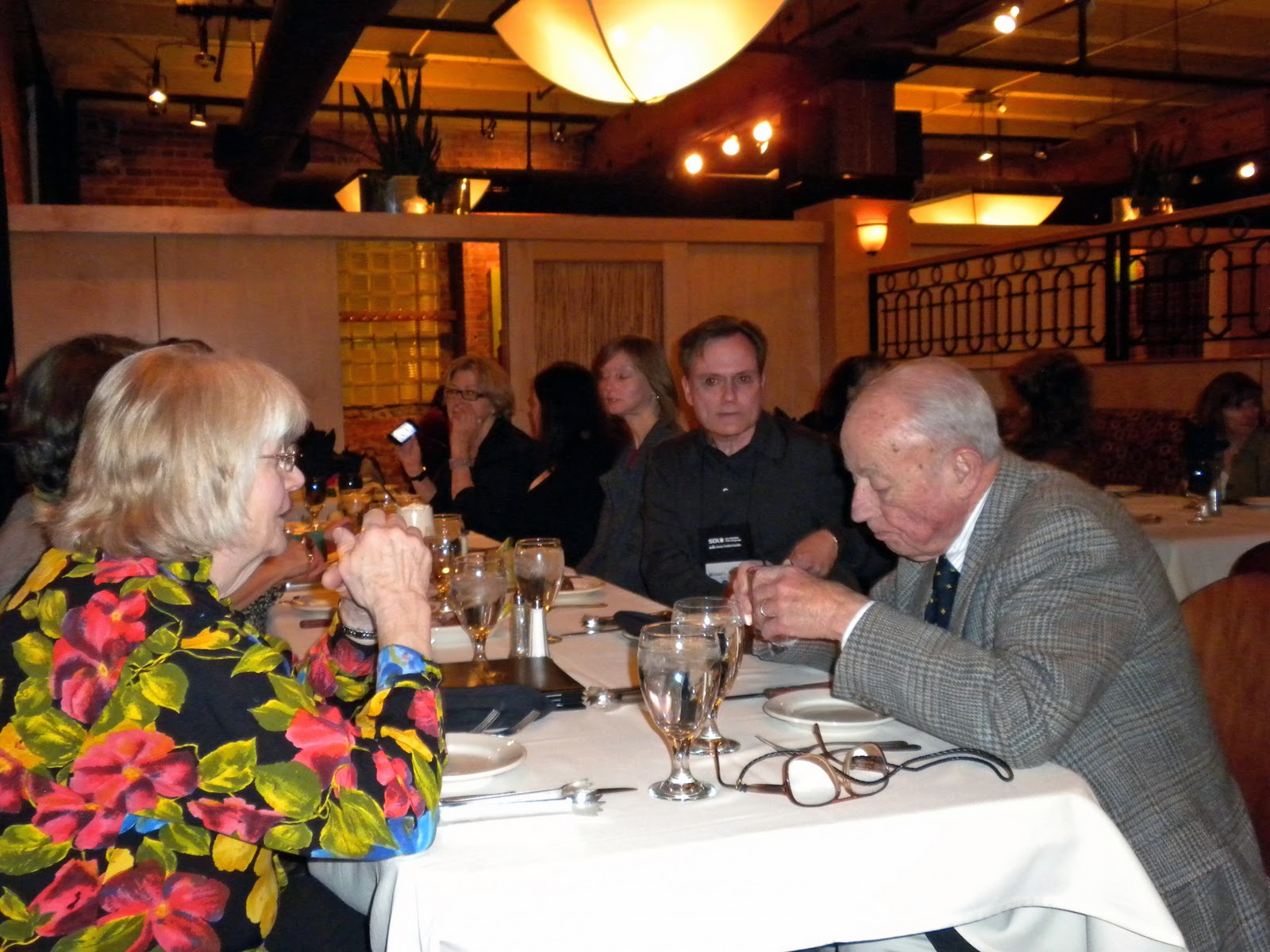
Les soirées à New York ne sont jamais ennuyeuses, mais la plus mémorable a été le dîner de groupe de la division française à La Bonne Soupe. Quelle excellente idée, merci Anne ! Ce fut une façon fort agréable, délicieuse et détendue de rencontrer de nouveaux collègues. François Lavallée a couronné la soirée en déclamant, à notre insistance, plusieurs de ses poèmes en alexandrins dont le fameux Cheval Vert (en français puis en « québécois ») qui ont fait rire le restaurant tout entier.

Pour conclure, ma première « croisière » à bord de la conférence annuelle de l’ATA a été un succès retentissant. J’en garderai un excellent souvenir personnel et professionnel et compte fermement en faire une tradition annuelle comme de nombreux autres participants. L’enthousiasme, la passion et la gentillesse de mes collègues lors de la conférence continuent de m’inspirer pendant ces longues heures passées en tête à tête avec mon ordinateur tous les jours : j’ai finalement trouvé bon port !
0

November 21, 2009

Ma première conférence (28-31 octobre 2009)

de Catherine Stevenson (cathstevenson@comcast.net)

Cette année, la conférence annuelle de l’ATA se déroule à New York, au sein du prestigieux Marriott Marquis, à deux pas de Times Square.

Jeudi

Le premier jour, j’arrive le cœur battant, curieuse et impatiente de découvrir ce que tous ces traducteurs et interprètes ont à dire sur l’état de notre profession, ses tendances, ses nouveautés.

Première découverte : les petits autocollants ronds et colorés indiquant les langues de travail. Tout un chacun essaie de deviner quelle langue se cache derrière le bleu foncé ou le vert clair. D’aucuns arborent pas moins de trois ou quatre autocollants tandis que d’autres, plus modestes ou moins savants, c’est selon, portent un seul autocollant, voire deux. Autre découverte : les happy few ayant décroché leur certification marchent d’un pas assuré, bombant un torse annonçant fièrement, non sans raison, qu’ils sont ‘CERTIFIES’. D’après ce que j’ai entendu dire, cette distinction est d’autant plus méritoire qu’elle n’est octroyée qu’à un candidat sur cinq, lors de chaque session d’examen.

Arrivée en retard à la session d’orientation réservée aux « nouveaux », dont je suis, je décide d’aller faire un tour au cinquième étage, où sont regroupés les agences de traduction, vendeurs de logiciels et autres entreprises en mal de recrutement. Je dégaine mes cartes de visite, échange quelques mots par-ci, quelques politesses par-là et je passe en revue tous les stands. Les agences me demandent de me connecter à leur site et de leur donner mes spécialités et mes tarifs, sésames indispensables à toute future collaboration.

L’après-midi, je me rends à ma toute première session, intitulée « How to successfully market yourself to translation companies » et présentée par George Rimalower. Son exposé est bien construit et logique et il offre une mine de conseils pratiques et judicieux sur la manière de rédiger son CV, le mode d’approche à respecter pour se faire remarquer par les agences et les règles de conduite à suivre pour être le parfait petit traducteur indépendant. J’en ressors avec le sentiment apaisant d’avoir appris quelque chose d’utile.

Autour de 19 heures, je vais à une session de « networking » pour le moins décevante. Comment expliquer en effet que des personnes ayant payé 45 dollars pour circuler entre les groupes, distribuer leur carte de visite et élargir leur réseau professionnel s’évertuent à faire exactement le contraire ? Je passe sur la malencontreuse pénurie de nourriture qui, bien que regrettable, n’explique pas, à elle seule, l’échec de cette session. 

Vendredi

Le lendemain, je vais écouter l’exposé de François Lavallée clamant avec ferveur : « Les slogans, j’en fais mon affaire ! ». Je suis emballée par le fait que cette session est en français et espère passer un bon moment… A l’issue de cette session, je suis conquise par l’analyse convaincante que nous expose cet orateur brillant sur la manière de produire des slogans en français et en anglais. Assurément, il a fort bien articulé ses arguments, les a assortis d’une kyrielle d’exemples bien choisis, sans pour autant oublier de parsemer ses propos de notes d’humour qui captent notre attention et la retiennent jusqu’au bout. Bravo, Monsieur Lavallée !

Après le déjeuner, je décide d’aller écouter Jutta Diel-Dominique, dont la session consiste en une séance de questions-réponses sur la préparation du tant redouté examen de certification de l’ATA. Elle est accompagnée d’un autre responsable de l’ATA dont le nom n’est malheureusement pas mentionné sur le programme. Cette session, dont l’intitulé exact est : « Preparing to take the ATA Certification Exam : Questions and Answers », est fort bienvenue et attire les foules. Madame Diel-Dominique répond aux questions avec aplomb, sérieux, diplomatie et finesse. Je ressors néanmoins sans avoir vraiment rien appris d’essentiel, malgré la qualité des réponses. En revanche, je suis particulièrement surprise, pour ne pas dire déçue, par une bonne majorité des questions posées. Leur nature me donne à penser que les candidats potentiels qui les soulèvent ne sont pas prêts à passer l’examen. J’ai l’impression qu’ils découvrent ce qu’est la traduction. A cet égard, je ressens une vive admiration envers Madame Diel-Dominique, dont le visage reste serein et posé en toutes circonstances.

Je descends ensuite au 6ème étage pour suivre l’exposé de Monsieur Jorge U. Ungo, dont la session porte le titre suivant : « Accentuate the positive : Making your résumé sing ». Monsieur Ungo est dynamique, passionné, intéressant. Il sait capter l’attention et ses exemples sont parlants et convaincants. Certains des conseils qu’il nous donne sont en contradiction avec l’exposé que j’avais suivi jeudi, ce qui me fait penser que la rédaction d’un CV n’est pas entièrement dénuée de subjectivité, mais dans l’ensemble, les recommandations vont dans le même sens et renforcent l’idée de clarté, de professionnalisme et de logique. Cet exposé est vivant et interactif et la volubilité de Monsieur Ungo nous remplit d’enthousiasme et d’énergie.

Je décide de « sécher » la séance de « networking », tant celle de la veille m’avait déçue ! New York by night, here I come !

Samedi

Ce matin est consacré à la réunion annuelle du département français. La salle est comble. Les conversations fusent. Tout le monde échange ses impressions sur la conférence. Madame Virginia Fox nous livre des informations à la pelle et nous parle des problèmes spécifiques à notre groupe. Elle lance un appel aux bonnes volontés pour prendre la relève du département français, qui manque cruellement de bras ou plutôt de plumes.

Avant de dire au revoir à l’insomniaque Big Apple, je me rends à une dernière session intitulée « Leave it to the Pros : Translation project management as a profession ». Dire que cette session me hérisse est un euphémisme : Corlett-Rivera, Mazza, Polakoff et Ritzdorf nous expliquent sans rire que de nos jours, la qualité des traductions importe peu, crise oblige. La mode est aux tarifs bas et pour s’en convaincre, il suffit de les écouter nous prédire que les agences de traduction, qui délocalisent déjà à tour de bras vers la Chine et l’Inde, n’ont pas fini d’abaisser leurs tarifs. Je repars déçue par les propos que je viens d’entendre et je m’en retourne vers ma Californie d’adoption convaincue que la qualité paie quand même et qu’il y a un créneau pour nous tous, traducteurs sérieux et attachés au travail bien fait.

Saint-Jérôme, Patron des traducteurs, priez pour nous !

November 16, 2009

2009 ATA conference: FLD photo highlights


Manon K. wins a Kindle from R.R. Donnelly

November 12, 2009

Merci à tous

Un grand merci à tous pour vos commentaires très positifs sur les sessions de l'ATA, à l'occasion de la dernière conférence à New York. Nous avons eu la grande chance cette année d'avoir neuf (9) sessions formidables avec la FLD et je tiens à remercier tous les présentateurs pour la grande qualité de leurs exposés, leur énergie et la passion avec laquelle ils ont su nous faire partager leur savoir. La conférence n'aurait pas été aussi réussie sans eux !

(Merci Grant Hamilton, Frédéric Houbert, Betty Howell, François Lavallée, Maite Aragones Lumeras et Laurie Treuhaft pour l'excellence de vos présentations !)

Un grand merci également aux bénévoles qui ont organisé les repas, j'aimerais citer en particulier : Anne Vincent, Bob Killingsworth, Karen Tkaczyk, Larry Schoffer, Jean Lachaud et Eve Bodeux. Grâce à eux, nous avons tous eu la possibilité de nous retrouver entre francophones, malgré l'emploi du temps très serré de la conférence et de goûter à quelques-uns des nombreux délices culinaires de New York !

Enfin, un grand merci à tous les participants et notamment à tous ceux qui nous aident à nous améliorer en nous donnant un feedback constructif, en devenant bénévole, ou simplement en nous encourageant dans la bonne direction. À ce propos, j'en profite pour remercier aussi Mylène Vialard, administratrice-adjointe de la FLD, pour son soutien sans faille et pour vous encourager à consulter notre blog et à y partager votre expérience de la conférence.

Excellente semaine à tous, où que vous soyez de par le monde ! (De New York à Nouméa, en passant par Montréal, Québec, Paris, Lyon, Genève, Johannesbourg et Kuala Lumpur !)

Très cordialement,
Virginia K. Fox
Administratrice de la FLD
0
0

November 10, 2009

Conference session review: “Translating Government/Administrative French>English” (preconference seminar Q) by Grant Hamilton

Review by Jenn Mercer (seminar announcement here)

Grant Hamilton’s seminar on translating government/administrative French>English documents took place the day before the official start of the 50th ATA Conference, but that did not seem to hurt attendance. There were around 30 translators in attendance and the audience grew as the talk went on. Fortunately for those who arrived late (including myself), Hamilton’s seminar had a simple structure and it was easy to jump right in.

The seminar was designed around a handout which divided examples into various categories containing two to seven exercises each.  These categories included “Slippage in Style and/or Meaning,” “Overly Literal Translation,” “Overreliance on Nouns,” “Words Could Have Been Removed, But Weren’t” and “Say What?” Hamilton started with a French phrase, provided a draft translation into English, and then opened the discussion by asking specific questions.  Hamilton also encouraged the translators to work on their own translations of the sentences. He then revealed his improved version of the translation.

The discussion which ensued was lively and instructive. Different solutions were presented, but also different translation philosophies. Hamilton listed “devotion to readability” as one of his key goals for the day and advised attendees that “we have to assume someone has a message for somebody.” Hamilton said that “you as a translator, having already made this effort [to understand this message], owe it to readers to simplify the sentence on their behalf.”  This statement and similar comments were made in the context of bureaucratic documents provided to ordinary citizens, however one participant pointed out that this level of freedom would not be possible when translating legal documents.

Hamilton is also to be commended on his bravery in putting forth both the draft and “possible” translations in front of such a large crowd of intelligent and eager translators. Despite the fact that the revised translations were a definite improvement on the originals, there were still some errors to be found. Only a few of these were clear-cut examples of right and wrong. For the most part, these disagreements reflected the real difficulties of translation where there are as many right answers as there are wrong ones. These disagreements and the discussions which they produced would have been enough to make this seminar worth attending. Another priceless benefit was the opportunity to commiserate on the level of bureaucratese present in these documents. Hamilton put it best when he said “this kind of text – you just want to cry when you see it.” I have certainly had this feeling myself and judging by the laughter of the audience, I was not the only one.

Due to Hamilton’s detailed preparation, the benefits of this seminar continued well after the seminar itself was over. Hamilton passed out a second handout at the end of the session which contained the text of the improved solutions along with his comments. This was convenient, but there were a few unexpected bonuses at the end of the handout. These included a list of 37 alternate translations for the French word “structurant” as well as a “Translator’s Checklist.” This checklist contained basic questions such as “Can any words be removed?” and “Can I say things in a simpler way?” As if this were not enough, the participants of both of Hamilton’s sessions received PDF’s of this document, plus a few extras such as a handy guide entitled “When you see the word...” This last guide contained examples such as “When you see... accessible, Ask yourself whether you should say... accessible, affordable, available.” All of the checklists and guides which Hamilton provided showed a consistent strategy of looking beyond the surface complications of French bureaucratic texts to deliver clear, and yet faithful, English translations.

This pre-conference seminar was the first one which I attended at this, or any, ATA event. I found it to be informative, but more than that, it was a great introduction to the joy of discussing translation issues with people who really love words. I would like to thank not only Grant Hamilton for his excellent presentation, but also my fellow translators who were so dedicated to finding the absolute best translation.
0
0